
Spring has sprung, and we are getting a preview of those wonderful April showers! From your friends at HCFA-WA, we are now past the Washington Legislature short session, and have some outcomes to share. We thank you for your ongoing support in driving to a Universal Healthcare System in the state of Washington!
In this issue:
- 2026 Legislative Successes
- March 2WSS Recap: Standing with our Somali Neighbors
- April 2WSS - Collaborative Care: A Model to support primary care providers and improve mental health access, equity, and quality. SAVE THE DATE: Wed., April 8, 2026
- March UHCC FTAC Recap
- News You Can Use
- April Events


2026 Legislative Successes
No Fooling!
Our primary legislative focus this year was on protecting access to critical health services and affordable health care for all Washington residents.
We also focussed on maintaining funding levels achieved last year for the Universal Health Care Commission and for the design of an auto enrollment process for those who lose Medicaid and qualify for Health Benefit Exchange plans.
We sent 13 Action Alerts on 15 Policy and Revenue bills we supported, and 10 of those bills have now become law or are on the Governor’s desk awaiting his signature.
This success was due in large part to our loyal supporters who contacted their legislators by email, telephone, and/or signing in “PRO” on the Legislature’s bill pages.
THANK YOU FOR YOUR ADVOCACY WORK!
In addition to our Action Alerts, the HCFA-WA page on the Take Action Network (TAN)
- Generated 113 separate alerts on 40 different bills
- Reported 2404 actions (PRO/CON votes and messages) to support our positions
- Counted 15 bills we wanted the legislature to pass
TAN offers a great opportunity to amplify our voice to other organizations. To join the Take Action Network please click here.
Together, we can move Washington forward on the pathway to universal health care.
Policy and Revenue Priority Bills
HB 2548 – Strengthening health care market standards.
What the bill does: Applies the principles of Washington’s Consumer Protection Act (CPA) to health care entities, prohibiting various anticompetitive business practices, including unfair or deceptive acts or practices.
Why it’s important: Protects consumers from sudden disruptions and surprise price increases when health care entities change ownership.
SB6103 Making payments for services provided by a rural emergency hospital subject to appropriation.
What the bill does: Requires legislative approval for Rural Emergency Hospital (REH) Medicaid payments, regardless of the beneficiary's managed care enrollment status.
Why it’s important: It supports rural healthcare as community needs evolve and evidence emerges about this new Rural Emergency Hospital model. It ensures fiscal accountability, protecting taxpayers while maintaining budget flexibility.
SB5395 Making improvements to transparency and accountability in the prior authorization determination process.
What the Bill Does: Modifies requirements related to determination notifications and the use of artificial intelligence as part of the prior authorization process for private health insurance and health plans offered to public or school employees.
Why it’s important: Helps reduce delays and inappropriate denials of medically necessary care, ensuring that qualified providers with relevant expertise are making prior authorization determinations, and will not be replaced by AI.
SB5917 Improving access to abortion medications
What the bill does: Removes requirements that the Department of Corrections (DOC) sell the abortion medications it possesses at a certain cost and instead allows, but does not require, the DOC to obtain payment for any abortion medications it distributes. Modifies the definition of “abortion medications” for these purposes to specifically include mifepristone and misoprostol. This law took effect on March 14, 2026.
Why it’s important: Strengthens Washington state’s ability to continue to provide reproductive health care as federal agencies and policy attempts to erode and remove it.
ESSB5845 Modernizing and clarifying timely payment requirements for health carriers
What the bill does: Requires health carriers to pay or deny a clean claim from a participating provider or facility within 30 days and to send a notice explaining a denial or a request for additional information from participating providers or facilities for claims that are not clean within 21 days.
Why it’s important: Increases patient access to care, financial stability for providers, relief from administrative burden, and accountability for insurance companies.
SJM8002 Concerning original Medicare costs and choice
What the bill does: Requests the federal government to take certain actions so that Medicare beneficiaries will not experience additional costs from choosing the original Medicare program and will have a choice between the public and private program.
Why it’s important: Levels the costs between Original Medicare and Medicare Advantage so that Medicare beneficiaries will not suffer additional costs by choosing Original Medicare and will have a genuine choice between the public and private programs.
ESHB2242 Preserving access to preventive services
What the bill does:
- Shifts the authority for defining which vaccines and other preventive services are covered from federal bodies to the Washington State Department of Health.
- Allows for more flexible, cost-effective purchasing of vaccines.
- Requires insurers to cover immunizations and other preventive services at no cost to enrollees,consistent with Department of Health guidance.
Why it's important: Federal actions have jeopardized continued free access to preventative services. This law ensures Washingtonians’ access to no-cost vaccines and other preventive services.
E2SSB5981 Protecting the integrity of the 340B drug pricing program.
What the bill does: Prevents drug manufacturers from restricting how safety-net healthcare providers access discounted medications through contract pharmacies.
Why it’s important: Protects vulnerable patients by enabling safety-net providers to use drug purchase discounts, and pass those savings on to patients. It also keeps patient data confidential from drug manufacturers.
SB 6182 - Establishing an abortion savings program.
What the bill does: Provides grants to maintain access to direct patient abortion clinical care services for individuals in the state, establishes a new assessment on health carriers subject to the insurance premium tax with initial assessments due and payable in 2027, and creates the Abortion Savings Account, where all revenue collected from the new assessment must be deposited.
Why It’s Important: Protects access to affordable abortion care for Washington residents.
SB 6346 - Establishing a tax on millionaires
What the bill does: Imposes a 9.90 percent tax on individuals on the receipt of income exceeding $1 million beginning in the calendar year 2028. Dedicates 7 percent of revenues to city and county public defense services, expands eligibility for the Working Families Tax Credit to include persons who are at least 18 years of age and who meet other eligibility requirements for the preference, and reduces certain other taxes. Exempts the individual income tax from a statutory prohibition on state and local income taxes.
Why it’s important: This bill would make Washington’s nearly century-old tax code fairer for working and middle-income families by asking the wealthiest Washingtonians to pay a little more to fund schools, health care, and reduce taxes for working families and small businesses.
Together, we can move Washington forward on the pathway to universal health care.
We sent the Action Alerts, and you took action! Your support made a difference. Thank you! We will be gearing up for the 2027 session before the end of the year, so stay connected through the HCFA-WA TAN page when the session begins.

Standing With Our Somali Neighbors: A Night of Inspiration and Action
On March 25, 2026, Healthcare for All Washington and Physicians for a National Health Program (PNHP) Washington co-hosted an extraordinary panel that reminded us why community-centered healthcare advocacy matters now more than ever. Click here to watch.
Three remarkable Somali women took center stage. Dr. Anisa Ibrahim, Clinical Associate Professor of Pediatrics and Medical Director at UW Harborview, arrived in Seattle as a six-year-old refugee in the early 1990s — and went on to become a founding force behind the Somali Health Board and a trailblazing physician dedicated to refugee and immigrant health. Najma Osman, MPH, Co-Executive Director of the Somali Health Board, turned a single public health course at the University of Washington into a life mission — building an organization that now employs 21 people and touches thousands of lives across King County. Journalist and advocate Amina Ibrahim, joining us from Cairo, moderated the conversation with grace, intelligence, and heart.
Their message was clear: the Somali community is not waiting to be saved — it is leading. Through entrepreneurship, cultural pride, and an unshakeable commitment to health equity, these women and their colleagues have built institutions, trained advocates, and shown up at every table where decisions about their community are made.
But the work is not done. Federal funding cuts have stripped vital programs. Fear and uncertainty are keeping patients from seeking care. And systemic barriers remain stubbornly in place.
This is precisely why organizations like HCFA-WA exist — to stand alongside communities like this one, amplify their voices, and push relentlessly for a universal healthcare system that leaves no one behind.
Be inspired. Get involved. The pathway to healthcare for all runs directly through moments like these.
Jump to blog for a broader view of the presentation.
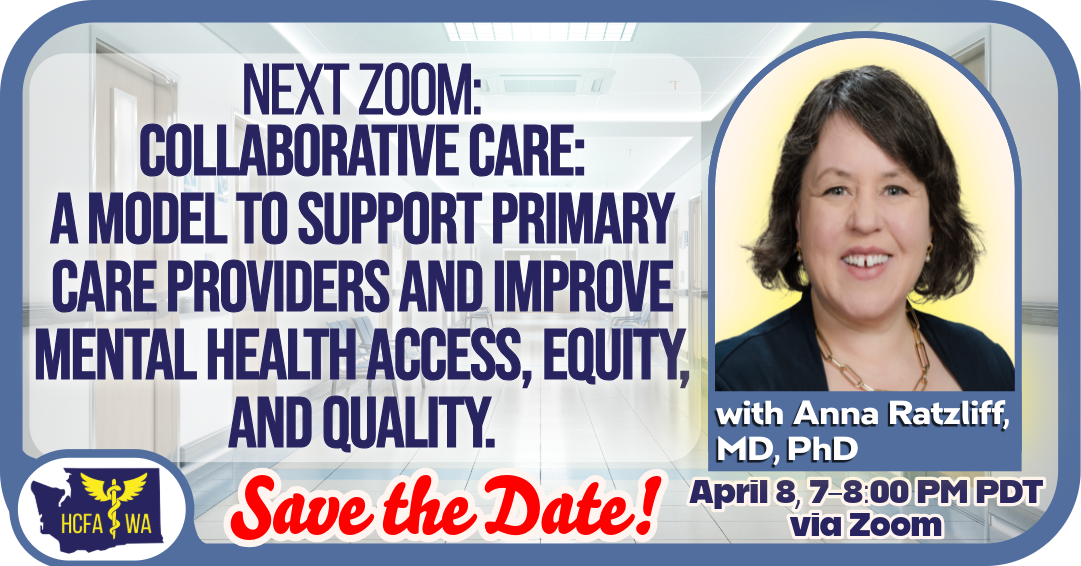
A Model to support primary care providers and improve mental health access, equity, and quality.
Save the date! Our 2WSS on April 8th will feature Anna Ratzliff, MD, PhD, the co-director of the AIMS (Advancing Integrated Mental Health Solutions) Center and Director of the UW Integrated Care Training Program for residents and fellows.
RSVP for Zoom info - look for it in the confirmation email!


Universal Primary Care: Design and Risks
By John Sobeck
The March 19, 2026, FTAC meeting advanced Washington State’s effort to build a universal healthcare system, with universal primary care as a possible first step. The approach emphasizes a phased, incremental strategy, using pilots in state programs before broader expansion. The goal is to improve access, control costs, and simplify administration while maintaining provider participation and system stability.
The Proposal Overview was presented by Jane Beyer, Sr. Policy Analyst for the Office of the Insurance Commissioner:
- Create a universal benefit package for primary care
- Primary care would be paid for and delivered distinct from health insurance coverage
- Health insurance wraps around and coordinates with primary care providers to cover all other services
- Build on evidence-based primary care models, such as UW AIMS Center Collaborative Care model, integrating behavioral health, primary care, and advanced primary care
- Payment goes directly to provider or provider organization—preferably on a pre-paid basis
- Insurance carriers provide supplemental coverage for other services
- System could be a platform for expanding universal coverage to other services
The proposed model centers on integrating behavioral health, primary care and advanced primary care in a team-based approach. Financing concepts include utilizing existing state spending for enrollees in publicly administered health care plans and potential federal support.
Key risks identified:
- Creation of a two-tiered system if supplemental access emerges
- Underfunding from flawed modeling approaches
- Unintended provider incentives affecting care delivery
- Rural system instability due to low volume and limited resources
- Concerns about privatization and fragmentation
- Who is the risk--bearing entity
Mitigation strategies include prospective payment models, standardized quality measures, and targeted rural pilots.
Provider Reimbursement and Implementation Pathway
The committee endorsed a stepwise transformation of provider payment, starting with:
- Reference-based pricing in public employee plans. Evaluate and if successful
- Out of network price caps for commercial market, evaluate
- Reference-based pricing for all commercial plans
- Potential transition to broader rate-setting and global budgets
There was strong emphasis on evaluating pilots before scaling, focusing on cost, access, and quality outcomes. The group also moved away from traditional financial “incentives,” favoring supportive, accountability-based models to reduce administrative burden and clinician burnout.
Financing and Modeling Priorities
A limited pool of funding will support modeling to inform system design. The central tension is between:
- Actuarial modeling for near-term payment and rate-setting
- Economic modeling for long-term system transformation
Priority areas include consumer costs, employer contributions, provider reimbursement design, and rural payment thresholds. These analyses are critical to advancing policy into actionable legislation.
Technical Design and Cost Control
Key technical discussions focused on:
- Prospective vs. retrospective payment models
- Risk adjustment methods and safeguards against ”gaming”
- Risk corridors to protect smaller and rural providers
- Bundled payments and global budgeting
Cost control strategy centers on incremental implementation, continuous evaluation, and expansion of reference-based pricing. There is also consideration of a future rate-setting or cost commission.
Stakeholder Engagement and Public Input
Public comment strongly supported prioritizing primary care, reducing reliance on managed care organizations, and ensuring equitable access. Stakeholders emphasized the need for clear communication, transparency, and collaboration, particularly in legislative drafting.
The committee plans to expand engagement through shared platforms, public input channels, and coordination with advisory groups and advocates.
Rural Health Considerations
Rural viability is a major constraint. Challenges include low patient volume, limited infrastructure, and risk of financial instability under new payment models.
Proposed approaches:
- Targeted rural pilots
- Payment adjustments and risk protections
- Expanded use of telehealth and collaborative care models
Key Decisions and Next Steps
Decisions:
- Advance universal primary care design
- Approve phased reimbursement reform strategy
- Expand tools for transparency and stakeholder engagement
Next Steps:
- Finalize modeling priorities and contracts
- Develop detailed policy proposals for upcoming meetings
- Launch and evaluate pilot programs
- Refine reimbursement principles and rural adaptations
- Prepare for key April and May commission milestones
Bottom Line
The committee is coalescing around a practical, phased path to universal coverage, possibly beginning with primary care and anchored in payment reform. Success depends on careful pilot execution, credible financing analysis, and managing risks—especially for rural providers and system fragmentation.
View the Meeting materials
Watch the Meeting Video
Next Meeting:
UHCC : Thursday, April 30, 2026, 2–5 p.m. - Details available here closer to the date.
FTAC: Thursday, May 14, 2026, 2-4:30 p.m. - Details available here closer to the date
Comment to the FTAC
- Speak during the designated public comment time at FTAC meetings. Sign up to provide public comment by 5 p.m. the day before the meeting occurs.
- Submit written comments at any time. If you submit your comments less than two weeks before a meeting, we’ll include them in the following meeting’s materials.
Comment to the UHCC
- Speak during the designated public comment time at UHCC meetings. Sign up to provide public comment by 5 p.m. the day before the meeting occurs.
- Email [email protected] at any time. If you submit your comments less than two weeks before a meeting, they will be included in the following meeting’s materials.
We urge our members to push for a single payer plan in their public comments.
Now Available, the Universal Health Care Commission 2025 Annual Report
ARE YOU INTERESTED IN SERVING ON THE UHCC?
Currently, there are two open seats on the Commission, subject to appointment by the Governor. Candidates should have knowledge and experience regarding health care coverage, access, and financing, or other relevant expertise. Apply to Serve here
Note: AI was used to assist in summarizing a transcript and notes from the meeting. All AI-generated incorporated material was reviewed and corrected for accuracy and thoroughness.

S.3822 - Break Up Big Medicine Act
The act is a bipartisan effort by Senators Elizabeth Warren and Josh Hawley to address the consolidation in the healthcare industry that drives up prices and squashes competition.
The Break Up Big Medicine Act aims to promote competition within the healthcare market by preventing certain health care companies from having ownership connections that can create conflicts of interest. The bill addresses the relationships between pharmacy benefit managers, insurers, drug wholesalers, and medical service providers. Key provisions include:
- Prohibition on Common Ownership: Corporate entities cannot own both insurance companies and medical providers.
- Divestment Timelines: Companies must divest within one year of the bill's enactment.
- Antitrust Enforcement: The Federal Trade Commission (FTC) and the Department of Justice (DOJ) will enforce the bill.
- Civil Actions: Entities can bring civil lawsuits against violators.
- Regulatory Reporting: The FTC and DOJ will provide quarterly reports to Congress on compliance.
S.3822 would require large healthcare corporations to divest vertically integrated businesses—separating insurers, PBMs, wholesalers, and providers—to reduce conflicts of interest and market concentration. It empowers federal regulators and states to enforce breakups and block future consolidation, with significant financial penalties for noncompliance. The bill represents a structural antitrust approach aimed at lowering costs and limiting the pricing and referral leverage of dominant, integrated health care entities.
Take Action:
Message your US Senators from Washington (Patty Murray and Maria Cantwell) with your support.
Or you can call the U.S. Capitol Switchboard at (202) 224-3121 to be connected directly to the office of a specific U.S. Senator or Representative by providing their name or your state/district. It is active and serves both the House and Senate.
Join the Take Action Network
Even though the Washington legislative session is over for 2026, 2027 is right around the corner! Stay involved as we continue to drive legislation related to a Universal, single payer health care system!
Join the Take Action Network from the HCFA-WA TAN page
Together, we can move Washington forward on the pathway to universal health care.

After Series of Denials, His Insurer Approved Doctor-Recommended Cancer Care. It Was Too Late.
Why do we tolerate prior authorization when it is used to kill us? A West Virginia man’s last, best shot at cancer treatment was denied until it was too late — exposing how prior authorization can quietly turn deadly for the patient and save the insurance company dollars. COMMENT: Do you have an experience with prior authorization you’d like to share? See comments to tell KFF Health News your story.
Single Payer 'Hands Down' the Best Way to Solve High Healthcare Costs, Advocate Says
While insurers cash in and families drown in medical debt, single-payer offers a clear way out: one public plan, fair prices, and universal care that puts people before profit, every time. "The thing that raises healthcare costs in the United States above competitor nations more than anything is the massive administrative waste that's due to a multi-payer private system...and profit-taking by insurance companies, drug companies, for-profit hospitals, and private equity," says Robert Weissman, co-president of Public Citizen.

|
Wed, April 8 |
2WSS: Collaborative Care: A Model to support primary care providers and improve mental health access, equity, and quality. |
|
| Tues, April 14 |
One Payer States 2nd Tuesday Speaker Series |
|
|
Fri, April 17 |
|
One Payer States 3rd Friday Updates and Conversation |
|
Thurs, April 30 |
|
Universal Health Care Commission Meeting |
Please support our work.
The perfect gift for every universal health care supporter, any time of year: Everybody In, Nobody Out t-shirts, winter scarves, and umbrellas.
★ Editor: Marcia Stedman ★
★ Graphics & Communications Specialist: Sydnie Jones ★
★ President: Ronnie Shure ★