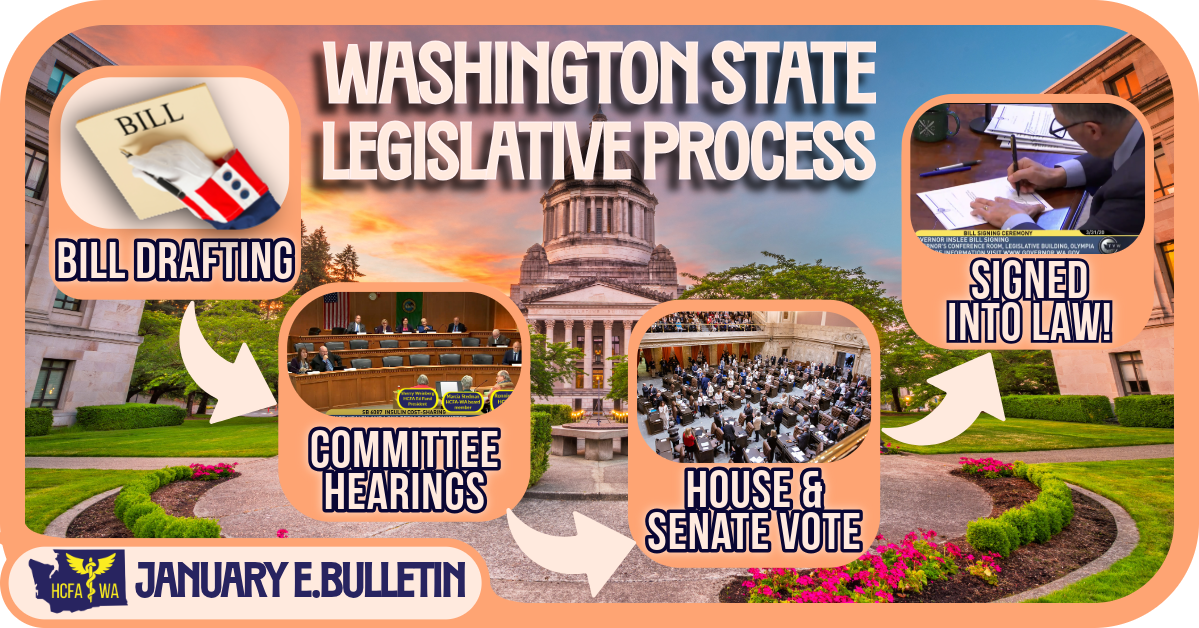
From your friends at HCFA-WA, we hope you are enjoying the winter season. 2026 brings a new Washington Legislative session! We thank you for your ongoing support as we work to move legislation forward that will continue to build the foundation of a Universal Healthcare System in the state of Washington!
In this issue:
- Take Action for Health Care Now!
- 2WSS January Recap
- January 2026 FTAC Summary
- Actions
- News You Can Use
- February Events
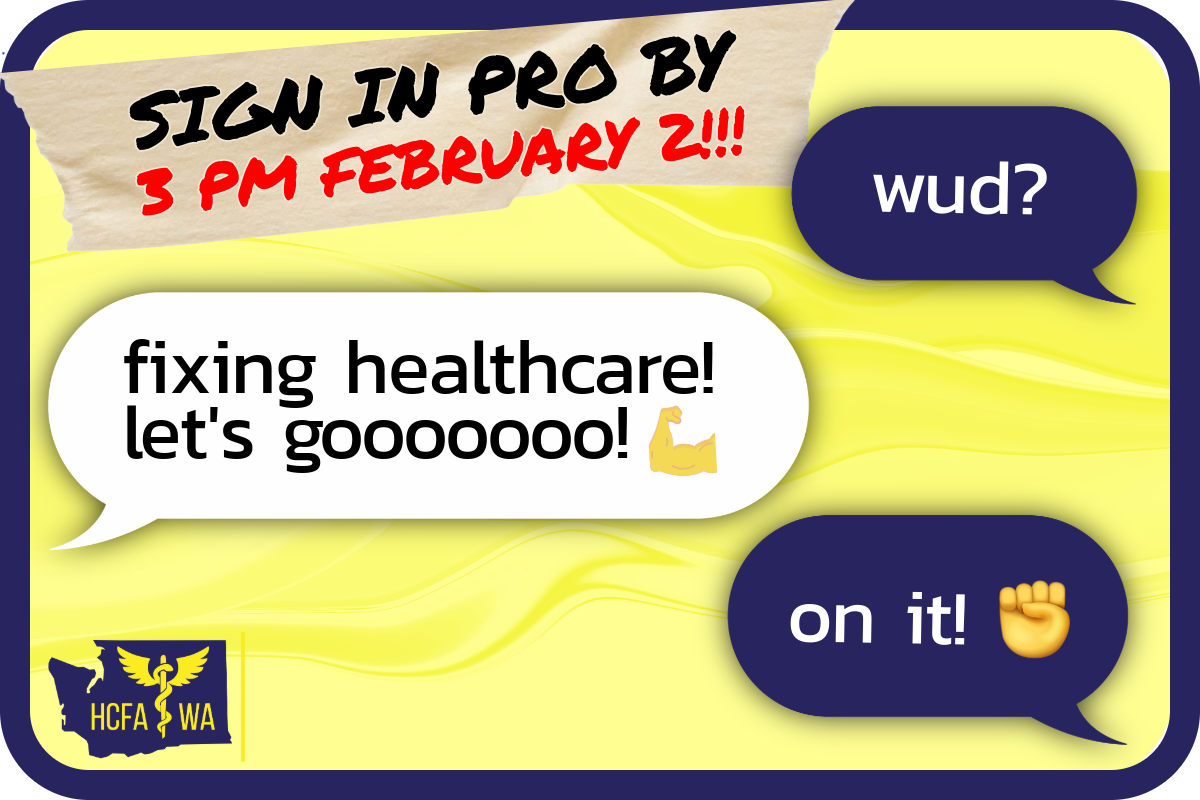
3 IMPORTANT BILLS NEED YOUR ACTION NOW!
HB 2073 – Funding health insurance premium assistance
What this bill does:
Requires each nonprofit health carrier to annually report the carrier's surplus amounts to the Office of the Insurance Commissioner (OIC) for determination of whether the carrier's surplus is excessive, and, if the surplus is greater than 600% of the carrier's Risk-Based Capital requirements, requires the carrier to pay 3 percent of the excessive surplus to the OIC for deposit into the State Health Care Affordability Account for the Cascade Care Savings program.
Why it’s important
Addresses the loss of the Federal enhanced premium tax credits for certain enrollees who purchase coverage through Washington's Health Benefit Exchange.
Mon., Feb. 2nd at 4:00 pm - Public Hearing in House Appropriations
ACTION: Sign in PRO by 3:00 pm on Feb. 2nd
HB 2626 - Increasing the insurance premium tax on certain health insurance providers.
What this bill does:
Increases the insurance premium tax on certain health insurance providers operating in Washington State and adds the health portion of disability insurance to what is covered under the state premium tax. The increased revenue would flow into the state general fund or the health benefit exchange account, depending on the type of coverage.
Why It’s Important:
Addresses the loss of the premium tax credits that are no longer provided by the Federal government as of Jan. 1, 2026. until this year.
Tues., Feb. 3rd at 8:00 a.m. - Public hearing in the House Committee on Finance
ACTION: Sign in PRO by 7 am on Feb. 3rd
HB 2683 - Health Carriers and Providers
What this bill does:
Standardizes credentialing procedures between health insurance carriers and providers, and effective January 1, 2027, a health carrier shall make a determination approving or denying a credentialing application submitted to the carrier no later than 30 days after receiving a complete application from a health care provider.
Requires health carriers to provide access to all billing and health plan coverage information to all health care providers and entities, including nonparticipating providers and facilities. Access to this information must be provided through a centralized location available on the health carrier's website or a website operated by the carrier that is available without requiring login.
Why it is important:
Improves transparency and efficiency between health carriers and health care providers and facilities.
Tues., Feb. 3rd at 1:30 pm - Public hearing in the House Committee on Health Care & Wellness
ACTION: Sign in PRO by 12:30 pm on Feb. 3rd
THANK YOU FOR TAKING ACTION!

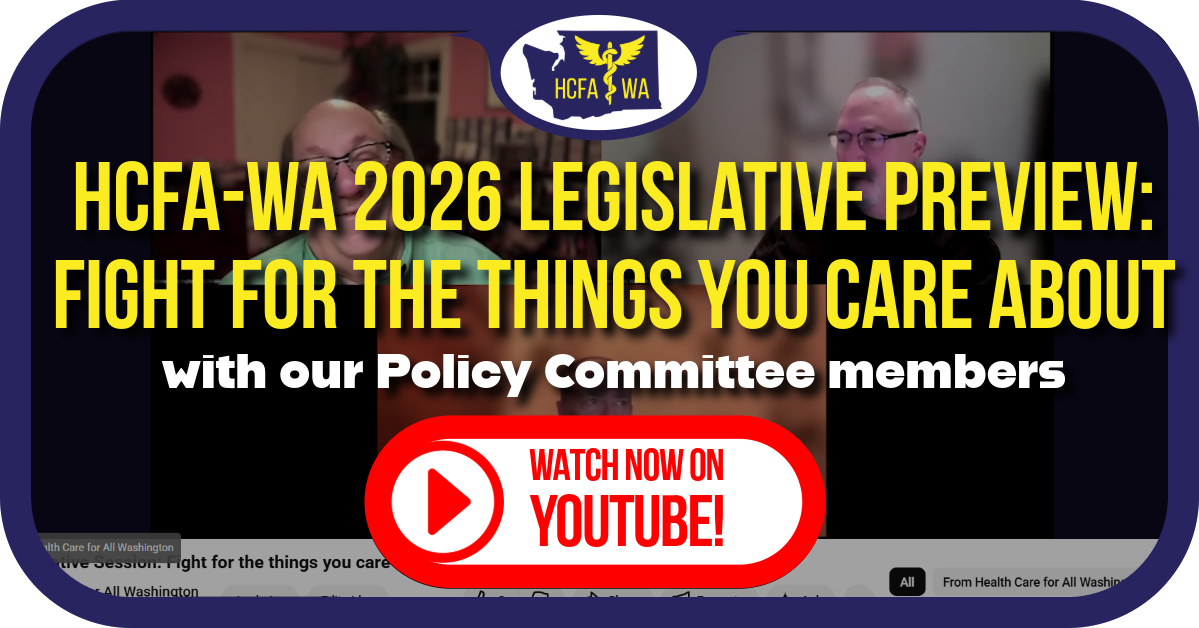
January 14, 2026 at 7:00 pm PT
HCFA-WA 2026 Legislative Preview:
Fight for the Things You Care About
The session convened members, partners, and advocates from Health Care for All-Washington and allied organizations for a comprehensive discussion on policy, strategy, and advocacy to advance universal health coverage in Washington State during the 2026 legislative session. The meeting opened with a land acknowledgment recognizing the Coast Salish peoples and other Indigenous nations, grounding the work in our commitments to equity, justice, and inclusive policymaking.
Participants reviewed the current political and fiscal environment shaping healthcare reform efforts, including significant state budget constraints and heightened legislative resistance to new spending. The agenda covered legislative priorities for the upcoming session, strategies to defend and incrementally expand universal health initiatives, and the importance of coordinated coalition partnerships. Attendees also received practical guidance on how advocates, clinicians, and community members can engage effectively with lawmakers through testimony, direct outreach, and grassroots organizing.
Special emphasis was placed on the interaction between federal and state policy changes, the need to sustain funding for key entities such as the Universal Health Care Commission, and the implications of proposed bills affecting healthcare financing and delivery. The discussion highlighted concrete engagement tools—such as advocacy networks, policy alerts, and coordinated messaging—to mobilize supporters and protect coverage, affordability, and access during a challenging budget cycle.
Q: What is being done to address the loss of Medicaid coverage resulting from recent federal legislation?
A: Key strategies include supporting budget provisos for auto-enrollment in the exchange for those losing Medicaid, increasing premium assistance funding, and targeting legislative efforts to close financial safety net gaps.
Q: Which bills are seen as priorities for protecting access and universal coverage?
A: Senate Bill 5387/House Bill 1675 (corporate practice of medicine reform), Senate Bill 5949 (pharmacy benefit manager tax), medical loss ratio bills (SB 5953/HB 2283), and measures preserving access to discounted drugs and preventative services are highlighted.
Q: What is the coalition's stance on deprivatizing Medicaid by removing Managed Care Organizations (MCOs)?
A: The coalition supports further study and advocacy for transitioning Medicaid away from for-profit MCOs towards a state-administered model (as Connecticut did), but legislative and/or executive support is required.
Q: How can individuals get involved or support the organization's work?
A: By joining the Take Action Network, responding to alerts, providing direct testimony or written statements, attending events/meetings, volunteering expertise (especially clinicians), and making recurring donations to sustain advocacy operations.

JANUARY FTAC MEETING - PROVIDER REIMBURSEMENT AND FINANCIAL FOUNDATIONS OF UNIVERSAL HEALTHCARE
The January 15 FTAC meeting focused on advancing the financial and provider-payment foundations of a future universal health care system in Washington State. The committee oriented new members, approved prior minutes, reviewed public input, and clarified FTAC’s continuing role as a standing advisory body to the Universal Health Care Commission. Discussion emphasized aligning work plans, sequencing deliverables, and preparing for actuarial and economic modeling needed to support future policy decisions.
Key discussions centered on healthcare cost growth, which continues to exceed affordability benchmarks, reinforcing the urgency of cost containment and payment reform. Members reviewed how claims and non-claims data—particularly through the All-Payer Claims Database—are used to track cost drivers across commercial, Medicaid, and Medicare markets, and highlighted gaps that require data consolidation and possible legislative authority to address ERISA limitations.
A major focus was refining guiding principles for provider reimbursement in a universal system. The committee debated whether payment rules should be “the same” or “consistent,” ultimately favoring flexibility to ensure access, sustainability, and adequacy—especially for rural and underserved providers—while maintaining payer equity. Principles emphasized affordability, access, equity, rebalancing payments toward primary and behavioral health, and improved data standardization, while rejecting overly prescriptive concepts such as strict site neutrality.
The meeting also outlined incremental transition pathways for provider payment reform, starting with reference-based pricing in public employee plans and potentially expanding toward broader markets and long-term global hospital budgets. Parallel discussions addressed physician payment reforms, incentives for provider participation (administrative simplification and predictable funding), and safeguards against unintended consequences such as provider exit or care shifting.
Finally, FTAC discussed the scope and timing of future actuarial and economic modeling, drawing on prior Milliman work as a reference. Potential analyses include global hospital budgets, sequencing transitions from current coverage programs, employer incentives, and alternative revenue strategies. The meeting concluded with agreement on next steps: revising reimbursement principles, advancing data work, gathering additional member input, and continuing close coordination with the Commission as universal system design progresses.
Next Meetings:
- UHCC: Thurs., Feb. 12, 2026, 2-5 pm - Details available here closer to the date.
- FTAC: Thursday, March 19, 2026, 2–4:30 p.m. - Details available here closer to the date.
There are two ways to share input:
For FTAC
- Speak during the designated public comment time at FTAC meetings. Sign up to provide public comment by 5 p.m. the day before the meeting occurs.
- Submit written comments at any time. If you submit your comments less than two weeks before a meeting, we’ll include them in the following meeting’s materials.
For UHCC
- Speak during the designated public comment time at UHCC meetings. Sign up to provide public comment by 5 p.m. the day before the meeting occurs.
- Email [email protected] at any time. If you submit your comments less than two weeks before a meeting, they will be included in the following meeting’s materials.
We urge our members to push for a single payer plan in their public comments.
Now Available, the Universal Health Care Commission 2025 Annual Report
ARE YOU INTERESTED IN SERVING ON THE UHCC?
Currently, there are two open seats on the Commission, subject to appointment by the Governor. Candidates should have knowledge and experience regarding health care coverage, access, and financing, or other relevant expertise.
Apply to Serve here

Join the Take Action Network — Make Your Voice Matter in WA LEG 2026
We invite you to join the Take Action Network (TAN), a powerful platform making it easy for Washington State voters to create real change. Whether you care about healthcare reform or other critical issues, TAN puts the tools directly in your hands to influence legislative action.
Why It Works
Dedicated volunteers analyze important legislation and track bills through the legislative process. When action is needed, you receive a simple email alert with everything ready to go—no confusion, just click and make a difference: right as a bill is introduced and as it is being voted on in the committee and on the floor of the House or Senate. You will know the action required as your legislators make their decisions.
Healthcare Advocacy
Other organizations, in addition to Health Care for All-Washington, use TAN to their critical legislation. In 2025 alone, HCFA-WA supporters sent over 3,000 messages through TAN during the session, resulting in six HCFA-WA priority bills becoming law, including protections against medical debt affecting credit scores and $514,000 secured for the Universal Health Care Commission.
What You'll Gain
Up-to-date information about bills that affect universal health care and other causes you care about. You will also have ready-to-use scripts for contacting your Washington legislators. In addition, you get invitations to participate in local meetings and community events. Join thousands of activists making Washington legislators more responsive to the people.
Action Item #1
Join TAN from the Health Care For All Washington link
Together, we can move Washington forward on the pathway to universal health care.
Action Item #2
Rally for Revenue - Tuesday, Feb. 10, Noon-1:00, Legislative Bldg, Olympia: “WA for All - Not Just the Rich!” Join a broad coalition of unions calling for fair, progressive revenue to protect jobs, strengthen public services, and ensure a Washington for all —not just the rich. With major decisions ahead this legislative session, now is the time to show your support.

The next election will be decided by America’s sick
America’s sick and high‑cost patients are framed as a powerful, emerging voting bloc that can decide the 2026 elections and reshape a profit‑driven health system that routinely harms them. "It’s time to target the cancer that affects every American — health care that puts profits over patients. In 2026, we will begin the work to rig our health care system forever in our favor by issuing our own denials for costly “pre-existing conditions” — the lawmakers who continue to put health care out of reach for the people who need it most. See you at the ballot box in 2026."
CMS Paying More for Medicare Advantage Patients Compared to Traditional Enrollees
The article highlights that Medicare Advantage (MA) plans are continuing to receive higher payments than traditional Medicare would spend for the same beneficiaries, a gap that MedPAC estimates has grown substantially. Despite policy efforts to rein in overpayments, MA plan payments remain elevated due to benchmark formulas, risk adjustment, and bonus structures.
MedPAC emphasized that coding intensity and favorable selection still inflate MA payments, meaning plans are often paid more for enrollees who are no sicker—and sometimes healthier—than those in traditional Medicare. Quality bonus payments and rebates further raise effective payment levels, even as CMS phases in technical adjustments intended to reduce excess spending.

|
Tues, Feb. 10 |
Rally for Revenue “WA for All - Not Just the Rich!” In person at the Legislative Building in Olympia - Details here |
|
|
Tues, Feb. 10 |
One Payer States 2nd Tuesday Speaker Series: |
|
|
Thurs, Feb. 12 |
|
Universal health Care Commission (UHCC) |
|
Wed, Feb. 18 |
|
From Cuba to Washington with Love |
|
Fri, Feb. 20 |
|
One Payer States 3rd Friday Updates and Conversation |
Please support our work.
The perfect gift for every universal health care supporter, any time of year: Everybody In, Nobody Out t-shirts, winter scarves, and umbrellas.
★ Co-Editors: John Sobeck & Marcia Stedman ★
★ Graphics & Communications Specialist: Sydnie Jones ★
★ President: Ronnie Shure ★